
How Do We Find the Thin Place Where Faith Meets Mind?


I grew up in a working class neighborhood and attended an evangelical Christian church. I generally hid my academic achievements because I sensed a prevailing opinion that intellectual activity was too removed from practical issues and might even lead one astray. I loved learning for its own sake. Was that chasing after forbidden fruit, like clandestine passion?  Of what use was it?

This attitude reflected our social and economic status more than any religious teaching. The missionaries I met during my growing up years were among the most intelligent, compassionate people I knew, a far cry from the stereotypical images often portrayed in fiction. Nevertheless, practical learning and revelation were prized over intellectual pursuit in my childhood community.

The novels that I write as an adult continue to grapple with a fish/fowl schizophrenia. I don’t think I write “Christian” fiction or at least not what is termed “inspirational” fiction. Many of my characters belong to the Christian fold, but their problems reflect a different level of struggle—searching for vocation, for purpose, or for meaning.

Evangelical MindIn grappling with the place of the mind, that is the use of the mind, in the Christian pursuit, I read a book written by Mark Noll, now history professor at the University of Notre Dame. His book, The Scandal of the Evangelical Mind, was first published in 1994. He sets out a challenge for evangelical Christians in the use of the mind. He describes the evangelical life of the mind as: ” . . . to think within a specifically Christian framework—across the whole spectrum of modern learning, including economics and political science, literary criticism and imaginative writing, historical inquiry and philosophical studies, linguistics and the history of science, social theory and the arts.”

For Christians to neglect the use of the intellect is to ignore a gift. One uses the gift in scientific inquiry, in searching for economic and political solutions, and other fitting pursuits. I explore this thin place where faith meets mind in my writing.

Oso, Washington, and Aleppo, Syria


Oso WashingtonWe live less than a hundred miles from the huge landslide in Oso, Washington, the tragedy that killed over twenty people. Several are still missing.
The citizens of the area have united to alleviate the tragedy. One of our grocery stores asks customers if they wish to round up to the nearest dollar for their purchases. The accumulated money will be given to Oso relief. Our hardware store also is collecting money. Customers can “buy” tools and supplies for the relief effort.

Banks and other organizations are accepting donations. Benefit concerts have been scheduled.

Such community effort and empathy are heartwarming.

I am reminded of tragic suffering in other places. I wish these tragedies could be alleviated, too.

Yet we should remember when sympathy involved us in a country called Somalia, with disastrous consequences to young soldiers. Or our engagements in Iraq which resulted in so many killed, wounded, and damaged Americans and Iraqi men, women, and children. Or Afghanistan, where young girls are targeted for wishing to attend school despite the price we paid there in lives and treasure.

We do well to be cautious of unwise involvement.

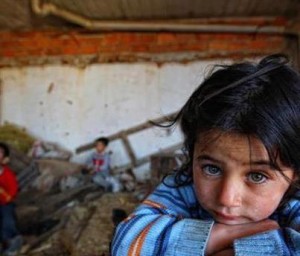
Child in AleppoYet the blood marked face of the little girl in Aleppo, Syria, stares out of the picture, uncomprehending as to why one would want to hurt her. She is dressed attractively. Her family must love her very much, and perhaps she will survive. Others, surely, are more damaged by the barrel bombs, full of shrapnel and nails. The bombs do not differentiate between military and civilian. Those who employ them do not intend that they should.
God knows we don’t need another military engagement. Better to press and wait for some kind of diplomatic solution. But perhaps we could spare sympathy and prayers for the people of Aleppo, Syria, as we rightly do for the people of Oso, Washington. And give donations to reputable relief organizations working with refuges who have fled in huge numbers.

Empathy for those horribly caught up in tragedy need not stop at the world’s boundaries.

Remembering Rwanda Twenty Years Ago: How a Young Rwandan Woman Found Meaning


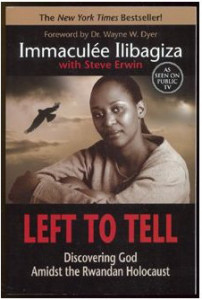
Left To Tell coverImmaculée Ilibagiza, a young woman born in Rwanda, tells of her horrifying time during the Rwandan massacres that began in April, 1994, twenty years ago this month. Most of her family were slaughtered.  Hidden in a bathroom with seven other women, she endured ninety-one days of cramped hiding. She tells her story in Left to Tell: Discovering God Amidst the Rwandan Holocaust.

Immaculée was born into a middle-class family of educators. She attended schools, including college. Suddenly the horror broke out. Hatred flared between otherwise peaceful neighbors. Terrified masses crowded into churches but were murdered anyway, sometimes burned with their churches—by those supposedly of their own Christian faith.

How did people who had given allegiance to the same Christian Jesus turn into angry, brutal mobs?

All of Immaculée’s family except herself and one brother died. After a miraculous survival, she was able to meet with the killer of her mother and one of her brothers. The man was now a prisoner, wearing dirty clothes, his hair matted, filthy. Before her, the murderer began sobbing. Immaculée said she felt his shame.

“I reached out, touched his hands lightly, and quietly said what I’d come to say.

‘I forgive you.’”

Then, she said, her heart eased. Later she told the astonished jailer, “Forgiveness is all I have to offer.”

We take away from this story the power of forgiveness to heal, as much for the sinned against as for the sinner. The only hope we have for dousing the bitter strife that inflicts the globe in a multitude of conflicts is the sacrifice of our hatred. We have a right to hate, but we choose not to hate and thus free ourselves by forgiveness.

Five Lessons This Christian Learned From Living in Muslim-Majority Countries


1. As I experienced life in a conservative Middle Eastern country, I learned what many Muslims of that country believe about Americans: Americans can’t live without binging on alcohol. Americans abuse drugs. They also favor couples living together without marriage, and they love X-rated movies. They don’t care if their daughters become prostitutes. Muslims who have never lived outside of their culture may believe most Americans are Christians.

Veiled women 22. Rural Muslims tend to become more conservative when they move to the city. Nomadic Arabs that we met while in the desert appeared less strict in matters of dress and other habits than their urban cousins.  This reminded me of the denomination I know best, Southern Baptists. Southern Baptists became more conservative when they left their rural roots. In 1990, Nancy Ammerman, then a professor at Emory University, wrote Baptist Battles: Social Change and Religious Conflict in the Southern Baptist Convention, which portrays this shift.

3. In the conservative country where I lived and worked, Christians weren’t free to worship openly, though western Christians usually worshiped without interference if they didn’t broadcast their religious activities or try to convert Muslims. Christians from other areas of the world—Ethiopia or the Philippines, for example—lived less protected lives.

4. Based on my knowledge of the arrests and mistreatment of some Christians in Muslim majority lands, I don’t see actions against Christians in this country as persecution. Some Christians may suffer in the sense that anti-war protesters suffer for civil disobedience, but it is not, in my opinion, persecution.

western women5. Some Muslims are dismayed at the infiltration of Western culture into their own. One of their writers called it “westoxification.”

Ammerman wrote in her 1990 book: “In a relatively undisturbed setting, religious practices are tightly interwoven into the fabric of life. . . . But when change occurs, everyday patterns of life are thrown into disarray . . .” So it is with Muslims as with Southern Baptists, notwithstanding that their beliefs are quite different.

Georgia On My Mind: Six Reminders from a Political Cartoon as Russia Invades Crimea


Country of GeorgiaI have a cartoon in my files from 2008 when Russia invaded the country of Georgia. David Horsey drew the political cartoon for the Seattle Post-Intelligencer. Georgia, located between Europe and Asia, choose to leave the Soviet sphere after the fall of the Soviet Union in 1991. In 2008, the Soviet Union invaded and annexed portions of their former satellite. The reactions were similar to our reactions today to Russia’s designs on the Ukraine.

From the cartoon in 2008:

1) Europe is concerned that the gas they buy from Russia may be cut off.

2) NATO is glad Georgia is not one of their members; otherwise, they’d have to do something.

3) The United Nations avoids the issue.

4) American cable news isn’t interested in the situation in Georgia. They continue with stories of celebrity scandals.

5) The President plays volleyball.

6) The average American is concerned only with the one word they think they understand: Georgia. Are Russians invading Atlanta?


No Vacation in Siberia. What a Shame.


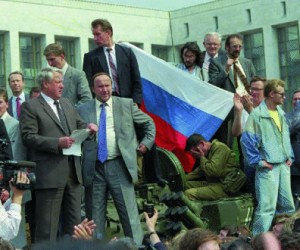
John McCainThe U.S. has issued visa sanctions against several Russian tycoons in protest of the Russian takeover in Crimea, meaning the tycoons will be prohibited from visits to the U.S.

In retaliation, Russia announced sanctions against several U.S. senators. I like Senator John McCain’s response the best:

“I guess this means my spring break in Siberia is off, my Gazprom stock is lost, and my secret bank account in Moscow is frozen.”

Sometimes humor is the best weapon.

What Are Our Choices in an Age of Revived Dictatorships?


A headline in today’s Seattle Times portrays the challenge: “Putin takeover signals a different kind of ‘Cold War.’” The Ukraine is threatened with loss of territory. Russians encroach on certain sections of that country, taking advantage of the confusion in the Ukraine after a corrupt leader was overthrown.

Vladimir PutinRussia’s Putin appears only one of many neo dictators, snatching a country back into the age of baronial privilege, in which favored elites rob the country of its wealth and ignore wishes of the majority. Ancient tribal hatreds threaten Libya. Egypt seems turned back toward another military government. South Sudan is again wracked by mayhem. Atrocities by a ruling minority group in Syria rival those of the Holocaust.

The headline, however, should remind us that we survived decades of that first, nuclear-threatening Cold War. We made mistakes, including ill-chosen wars of choice. However, we avoided a massive conflict  with the Soviet Union. We waited through a period of dictatorships while we probed diplomatic opportunities. We grew our economy and created a vibrant middle class. And eventually our patience was rewarded.

Years ago, one of our politicians said that our nation’s differences stop at our shore. We can choose emotional, knee-jerk reactions to these crises or we can choose patience, well-considered responses, and a spirit of cooperation, both among our political parties and with our allies.

Who Do We Blame When Kids Fail?


When I was growing up, my parents enjoyed life with each other and with my brother and me. They read books and newspapers and discussed ideas at the supper table. My father always had a job. My mother worked part time as well. The money coming in placed us in the middle of the middle class, far from the one-percent, but we never missed a meal or suffered major medical expenses that weren’t covered by insurance. We were part of a loving church community.

Why shouldn’t I be judged by a higher standard of accountability than children born in circumstances like New York Times columnist Nicholas Kristof describes: “But if you’re one of the one-fifth of children in West Virginia born with drugs or alcohol in your system, if you ingest lead from peeling paint as a toddler, if your hearing or vision impairments aren’t detected, if you live in a home with no books in a gang-ridden neighborhood with terrible schools — in all these cases, you’re programmed for failure as surely as children of professionals are programed for success . . . When kids in poverty stumble, it’s not quite right to say that they ‘failed.’ Often, they never had a chance.”

To whom much is given is much required. Hold all of us accountable. If we blame poor Americans who make irresponsible choices, Kristof says, blame rich Americans who are irresponsible as well. You could start with the ones who scammed Americans with mortgage abuses.

The One Commitment We Can’t Change


Ross Douthat, New York Times columnist, quoted from Jennifer Senior’s new book, All Joy and No Fun: The Paradox of Modern Parenthood in a recent column: Parenthood is “the last binding obligation in a culture that asks for almost no other permanent commitments at all.”

In this sense, Douthat says, it isn’t necessarily that family life has changed so dramatically in the last few generations. Rather, family life “stayed the same in crucial ways —because babies still need what babies need—while outside the domestic sphere there’s been an expansion of opportunities, a proliferation of choices and entertainments and immediately available gratifications, that make child rearing seem much more burdensome by comparison.”

What has changed are the choices: “between the lifestyles and choices available to nonparents and the irreducible burdens still involved in raising children.”

We change marriage partners, or don’t bother to commit to marriage in the first place. However, babies call for commitment unlike any other task in our world today. Children who lack committed parents or who don’t find parent figures are less likely to handle life successfully. In contrast, those with committed parents greatly increase their chances for a meaningful life.

We often lack the community support enjoyed earlier. Incomes may have to be adjusted also. The disparity between the lifestyle of DINCs—double incomes, no children—and those of married couples with children, much less a single parent with a child—are documented.

We take our careers more seriously than ever before. Parenthood is a career that requires as much commitment as any other.  Children may fail or not, but so may any career. Most children born today live after us, unlike the average career.

Who of the Religiously Uncommitted Will Build Our Hospitals?


Eboo Patel, an American Muslim, asks “What will happen to U.S. civil society as the pews empty out?” He refers to the many social service agencies built over time by Christians and members of other faith traditions. (“‘Nones’ and the Common Good,” Sojourners, March 2014.)

Some atheists are attempting to offer communities for the uncommitted, as well as services to the vulnerable. But will their beliefs allow the dedication necessary, over centuries, to build hospitals and universities? Will they have the compassion and stamina to staff homeless shelters, addiction centers, and disaster relief efforts?

Some of the uncommitted exhibit more compassion, character, and intelligence than many of the religious. Some are indeed involved in what can only be called good works.

Nevertheless, they will have a lot of catching up to do. Patel cites Robert Putnam, Harvard social scientist, in noting that three-quarters of philanthropy goes to religiously affiliated groups. The religiously affiliated know a long tradition of healing and ministering to the poor.

Christians, in addition, are commissioned to “preach the Good News.” We had better make sure the news we preach is good, not hate-filled or power-driven. This may be what separates us from other do-gooders.

What Do I Know About Drugs, Anyway?


My state, Washington, is one of two states (Colorado is the other) that has legalized marijuana for recreational use. For some, pot has joined beer, wine, and other alcoholic drinks as a leisure pleasure.

Caveat: I remain one of those increasingly rare creatures, a teetotaler. I’m also a Christian. I’m not, however, an abstainer because I’m a Christian. Nor do I expect most others to be abstainers.

As a young person in a conservative church, I was influenced in my teen years by religious arguments. In examining my Christian Bible, however, I can’t see that it forbids alcohol as long as imbibing it is done responsibly. Jesus, after all, turned water into wine at a wedding celebration.

I think the fact that neither my family nor my close friends drank influenced me more than religious teachings. We had lots of fun without it. And as a woman with a history of breast cancer in my family, those articles about alcohol consumption and a higher incidence of breast cancer always get my attention.

Then, too, I wonder sometimes that my tendency to depression might lead me to over indulge during a down time. All in all, maybe it’s better if I stay in my abstainer mode. I also save money that way.

I accept the fact, however, that I live in a world where most folks will choose to use some types of drugs. I’ve come to understand that I don’t know enough about those drugs. Obviously, overindulgence leads to things like the horrible loss of life in automobile accidents. It contributes to domestic violence. It would seem that certain people are alcoholics and must learn to do without alcohol to avoid destruction. I’ve read that alcohol and drug use at an early age can lead to harmful brain changes.

Then, of course, there is Philip Seymour Hoffman, who died so tragically in a drug overdose. Articles after his death mentioned that once you’ve become a heroin addict, the brain changes, even in an adult, so that you will always crave it.

So I’d like an honest, comprehensive assessment of drugs, including alcohol, and their effects on different kinds of people. In this postmodern world, our moral behavior is increasingly a personal choice, not bound by cultural norms. I’d like those choices to be responsible and disciplined, based on knowledge rather than instant gratification or peer pressure.

What’s This New Domesticity Movement?


Emily Matchar in her book Homeward Bound: Why Women are Embracing the New Domesticity says this movement “relates to our growing disenchantment with the mainstream workplace, which has failed young people, mothers, and families in so many ways.”

Complaints about “work/life balance” and “antifamily policies” surfaced after women entered the workforce in large numbers. Matcher’s book addresses these issues. As I read her book, I asked: What was so great about the workplace for men before women joined it? Isn’t it important for men to have a work/life balance, too? Singles as well as marrieds? Families and also childless couples? What about the retired, with more relaxed schedules but still with skills to share?

Matchar calls on men as well as women to change. “We need to make sure that the rallying cry of ‘take back the home’ is shouted just as loudly by men as by women.”

Should a career dictate our consuming interest in life?  Men and women live longer than in generations past. We have more years for both careers and other pursuits. Why should all our years from young adulthood to sixty-five be given over to careers? Why should the population then be divided into “career” and “retired”? Why does consumption so rule our lives, guaranteeing that most adults must work full-time to sustain it?

Perhaps we could encourage a less materialistic model which allows dropping out occasionally to focus on children or schooling or creative pursuits or civic work or taking a sabbatical in a monastery or the deliberate choice of part time work for several years.

How about a new dialog blending domesticity (community?) and career for all of us?

War-War or Jaw-Jaw?


Acording to The New York Times columnist Thomas Friedman, not everything that happens in the Middle East is about us. At some point the region has to grow up.

We no longer have the desire nor the means to do the heavy lifting, not to mention that our past military excursions there have shown mixed results, at best. The possibility that the United States might bomb Syria if Assad didn’t give up chemical weapons was hugely unpopular in this country. A couple of decades or so ago, pictures of children dying of starvation in Somalia led us to intervene militarily in that country—disastrously. Today, even images of grotesque deaths from chemical warfare do not move us to consider similar actions.

Friedman’s column suggests that a lack of pluralism plagues the Middle East. The region will be forever convulsed, he says, unless it embraces diversity. The Iraqi Shiites have to allow Iraqi Sunnis to be part of the power structure, as well as other minorities.

When the Muslim Brotherhood in Egypt overplayed its hand by trying to turn a fairly secular nation into an Islamic republic, people revolted. Now the military may be doing the same thing in reverse by persecuting the Islamists.

Don’t even begin with the Syrians: each group appears to lust after the annihilation of the others.

Perhaps when enough blood has been shed, the principals will no longer confuse governance with religion. They may reach that stage sooner if we stay engaged and provide opportunity to change from “war war” to “jaw jaw.” Winston Churchill coined this phrase during the time of another seemingly endless confrontation called the Cold War.

Minimum Wage at Ten Dollars Plus Per Hour? Fifteen Dollars?


SeaTac, Washington, the town surrounding Seattle/Tacoma’s main airport, recently passed legislation increasing the minimum wage to fifteen dollars an hour. (The state of Washington already has the highest minimum wage in the country at $9.32.) Politicians, economists, and entrepreneurs are scrutinizing the results. What will the increase do to the economy, to workers, to businesses?

Some rally around the measure, saying that even low income jobs should pay a living wage. Some want a higher minimum wage, but not that high. President Obama has called for $10.10 per hour. Some want a gradual wage increase, some all at once, as in SeaTac.

Some suggest that a higher wage, mostly falling into the hands of the less well-off, will boost our economy. Since this population normally is able to spend only for essentials, they will spend almost all of it.

Others say businesses, especially small ones, won’t be able to absorb the costs and will go bankrupt, causing job losses. (Many proposals exclude small businesses, although critics say if some companies offer higher wages, all must do the same to retain workers.)

Others argue that the government pays other costs for inadequate wages. These include medical expenses or subsidized health insurance (low-wage workers often cannot afford health insurance without government aid), food stamps (most low wage workers aren’t single teenagers; many have families to support), and other benefits. These government expenses would be less, the argument goes, if the workers were paid more and had benefits. Some suggest, in fact, that taxpayers subsidize businesses that do not provide adequate salary or benefits.

Washington state, with the aforementioned highest minimum wage in the nation, had an unemployment rate of 6.6 as of January 28, 2014, about the same as the nation. Some states are lower, some higher. Some with lower rates are benefitting from labor scarcity caused by the resource boom in states like North Dakota. Minimum wage appears to influence but is not the sole factor in unemployment or employment.

Part of the problem is what is tagged the “hollowing out” of the middle class, because mid level jobs are more and more being performed by computers. If our job structure is permanently changing, perhaps we should ask ourselves first: what is fair? We are speaking of workers, not the jobless. What is the minimum wage supposed to cover? If middle paying jobs are decreasing, what is fair for low wage workers who increasingly come from the former middle class?

Genreless Genres?


Genre, so my Oxford English Dictionary defines it, is “a style or category of art or literature.” Genre novels are classified as romance, mystery, science fiction, suspense, crime, political, and so on.

A number of acclaimed authors write novels not easily categorized as to genre, like Jodi Picoult.  In an article in Writer’s Digest, Picoult said her genre is the very lack of one. She writes on diverse subjects. Often the subjects have to do with social or moral problems.

Piccoult is tagged by some as a “commercial” writer, by others as a “literary” writer. Supposedly, commercial writing is more dependent on plot and easily fits into a genre category, while literary writing is more dependent on character.

Some authors now write novels that classify in more than one genre: romance/mystery or political/suspense. Some go even further, mixing genre and literary, like a novel I saw tagged as a “literary mystery.” The phrase “upmarket fiction” has been coined to describe character-driven fiction that appeals to a large audience.

What about “Christian” fiction? Obviously, it isn’t itself a genre since it includes many genres: romance, science fiction, mystery, crime and others. What qualifies a book as Christian? Is it a story in which one or more of the protagonists self-designates himself or herself as a Christian? Does it, then, include classics like The Brothers Karamazov?

While the whole publishing industry is roiled by ebooks and digital formats, the genre category also is up for grabs.

Market Forces and Good Works


The phenomenon of secular interests taking over “good works” from religious groups has gone on for centuries. Once governments understood the benefits of an educated population, for example, they began taking over the education function from religious institutions for much of the population, offering free schooling for all children. Social security and other programs that aid the less well-off have increased consumer purchasing power when citizens were lifted out of poverty, gaining favor with some economists.

Now corporations have entered the picture.

“Philanthropy Meets the Market,” an article in The World in 2014, published by The Economist, predicts that corporations will invest more in goods works, such as improving water quality. From enlightened self-interest, certain corporations (i.e., soft drink companies) understand that world markets must have access to safe water. As populations grow and use more water not only for drinking but for agriculture, water supplies become endangered. Corporations now pay for activities like digging wells for fresh water. Until recently, charitable and religious groups led in this kind of work.

Those who wish to do good, however, expect to find plenty to do. No doubt enough need exists to keep all comers busy for some time.

Saving Mr. Banks, Fiction But Real


The movie Saving Mr. Banks isn’t your typical Hollywood movie of recent times. The movie has no violence or explicit sexual scenes. No one is tortured or blown up or chased by bad people.

It even begins with a flashback. The flashback has no exciting “inciting incidents,” merely a little girl and her father playing an imaginary game in an Australian park.

Saving Mr. Banks is loosely based on the making of the popular movie Mary Poppins by Walt Disney. That movie, in turn, was based on books by Pamela Lyndon Travers. According to accounts of Travers’ actual relationship with the making of the movie, she remained disappointed with Mary Poppins. Thus, a great part of Saving Mr. Banks, it would seem, is fiction. Nevertheless, like all good fiction, it draws us in and gives us insight.

As movies go these days, it begins slowly. We are taken in by the characters and the choices they make, some heartbreaking. We see Travers’ father, a bank employee, unable to overcome his alcoholism, humiliating his family, finally dying too young and unable to keep his promise to his daughter to “never leave her.”

Walt Disney’s own severe childhood is counterpart to the tragedy of the author. His playful films are his answer. He overcame severity by clinging to his gift of whimsy and using it to bring a bit of fun to the world. Suffering is redeemed in part.

Seemingly unsuccessful people may do good things for their children that live on.The work-driven Mr. Banks of Mary Poppins, the audience is given to understand, carries a piece of Travers’ father. Mr. Banks does love his children. This Victorian father is even capable, finally, of flying kites with them.

Working Less In Order to Work More?


A report from the nonpartisan Congressional Budget Office predicts that the Affordable Care Act (Obamacare) may result in some Americans choosing to work less. According to the report, they may choose to work less (meaning, presumably, in paid employment) because they don’t have to remain in a job solely to gain health insurance. The report raises interesting questions.

First, why have we allowed health insurance to be tied to jobs? This results in unenthusiastic workers who can’t change to jobs more suitable to their interests. Corporations also must compete on the world market with corporations from Europe and other countries who don’t need to pay for this insurance because their governments provide it.

Second, why is health care so expensive in the United States? Canada and other advanced countries have, studies indicate, healthier populations than the U.S., but at less cost. Apparently, many Americans could afford to work less at paying jobs if they were guaranteed insurance for unexpected medical expenses.(Obviously, the working poor need all the work they can find.)

Third, why will workers supposedly work less? Do they plan to watch more TV in their extra hours? Or do some wish to spend more time with their children? Or take care of elderly parents? Or engage in civic or charitable work? Or experiment with a business of their own? Or write a novel?

Since the beginning of the industrial revolution, work has narrowed to fit one pattern for men and eventually for women who entered the labor force in increasing numbers. Everyone works a certain number of hours per week, period. Special arrangements have to be made for sickness, family emergencies, time off to explore other interests, or extreme weather.

The changes in health insurance could present an opportunity to define new work patterns. Such patterns might allow Americans flexible work schedules and hours more suited to individual goals and the unpredictable world they live in.

Big Boxless Theater


Before we moved to our small town, I thought all movies were now the big box kind. You buy your ticket from a nameless receptionist and find your way to the slice of the box for the movie you have chosen. You stumble among the seats in the three-quarter darkness to an empty one, trying to avoid stepping on toes. You listen to screen advertisements for ten minutes or so, depending on how early you made it to the show.

Then we moved here and discovered the leftover, pre-World War II theater on our town’s main street. It was built in 1937. In spite of resembling something a Soviet collective might have created, it’s one of the community’s beloved icons.

Before the show, we line up outside and take our place, carrying on conversations with those we know. We greet the ticket seller and perhaps nod to the movie’s owners, who often stand by to open the door. We might buy refreshments from the stand squeezed into an alcove just before we enter the viewing area.

Since we have only one movie, the lights remain on until show time. We greet friends and neighbors, maybe carrying around our popcorn to walk the aisle and check on who’s here. A few people stare at cells or tablets but most talk or observe. No reason to shush anyone. As the proprietors of the theater point out, it’s noisy, a community kind of noise. If somebody is celebrating a birthday, friends make it known with the appropriate song.

Once in a while, the owners invite a local musician to play a violin or to sing before the movie begins.

The lights dim. We hush. The previews flash by, then the movie. When it’s over, we may stay and watch the credits, discussing the story. Then we slowly line up and crowd out, still talking with friends.

Some of us living close by walk home. The line of cars for everyone else lets those checking the streets from a window to pretty much guess what time it is. The movie’s over for another evening.

That’s community in a big boxless society.

Border Crossings


My husband and I surveyed the beautiful Inner Harbor in Victoria, British Columbia, Canada, a few weeks ago and explored it for hours. We had arrived from our home in Washington state, taking an hour-and-a-half ferry ride across the Strait of Juan de Fuca.

An American walking around Victoria feels at home. Many stores and hotels accept U.S. money, though they may return Canadian change. Other differences strike the observer: more recycling, subtle accents, and metric distances and weights.

I once attended a business luncheon in Montreal that showcased economic ties between Canada and the U.S. An American businessman commented on the similarities between the two countries. He didn’t think of Canadians and Americans as all that different, he said.

Mistake, I thought. Canadians generally consider themselves quite different from their neighbors to the south and sometimes resent our taking them for granted. The differences range from stricter control of guns to what they consider as less arrogance in world affairs.

The border that we crossed to reach British Columbia is one of the friendliest in the world. It is still a border. Much has changed since the 1990’s, when I lived in Montreal and would cross on holidays into New York. The agent at the small border post greeted me with a “hello, how are you, ma’am,” and the briefest of glances at my passport. In those days, an American didn’t even need a passport following short stays in Canada.

In 1999, an Algerian,  Ahmed Ressam was arrested coming into the United States from Canada with a trunk of explosives. He later said he planned to bomb the Los Angeles airport. Ressam was arrested at our own point of departure for Victoria—Port Angeles, Washington.

The aura of peace and frontier isolation as one looks from the small town of Port Angeles to the snowy peaks of the Olympics was shattered that day. Now American citizens must have a passport or other enhanced documentation when they return into the United States from Canada.